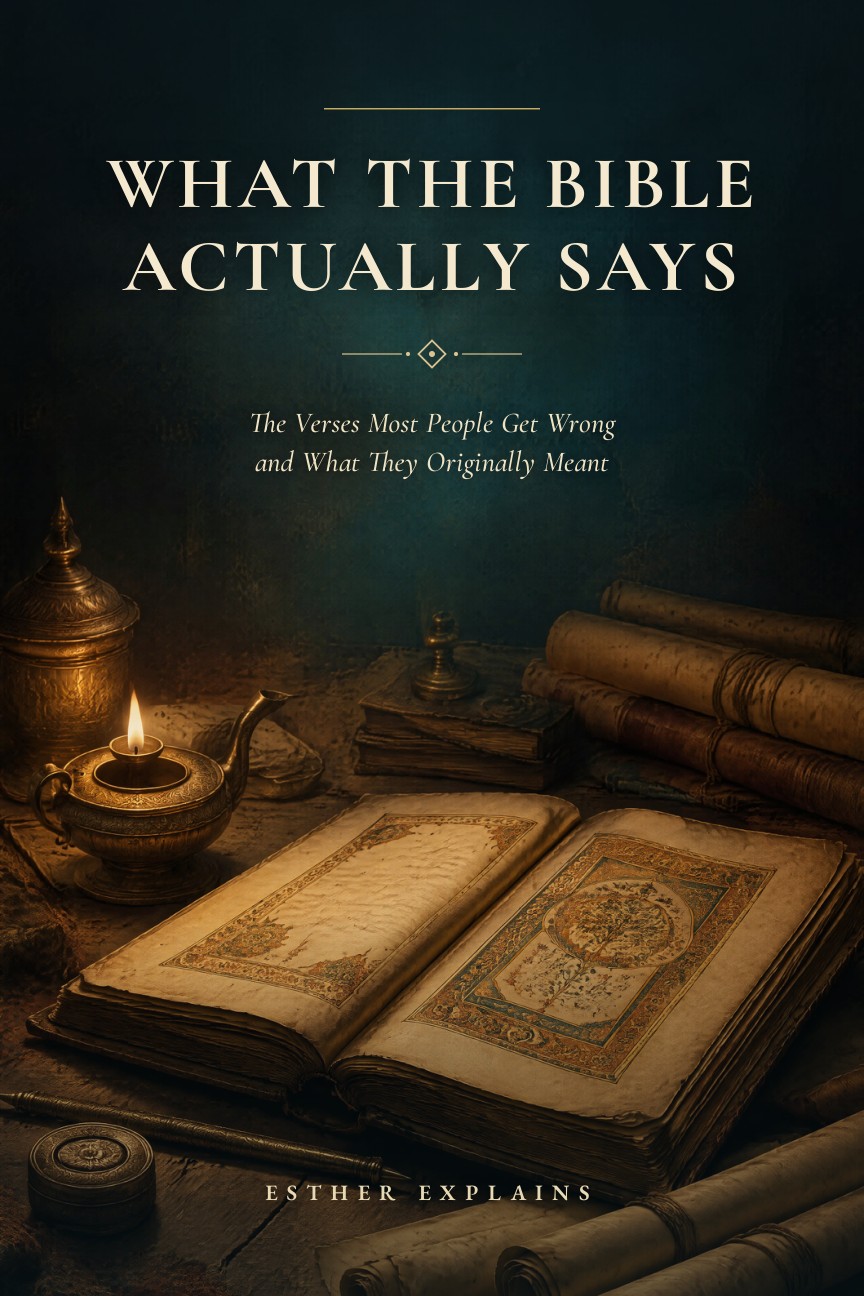
Ninety short chapters on where your Bible came from, the verses everyone quotes wrong, and the words that changed on the way to English. Each one tells you what the text actually says, what the world around it looked like, and where careful people still disagree.
The point of this book is to hand you the tools, not the conclusions.
Before You Begin, page 3
I make videos explaining Bible passages. The most common message I get is some version of the same sentence: I have heard this verse my whole life and I never knew that. That reaction is why this book exists.
Most people were handed a small set of verses, in English, with an application already attached, and were never told that the verse had an author, an audience, a language, and a paragraph around it. This book gives the verse back its paragraph.
Every one of the ninety chapters ends with a section called The Limits, where I say plainly what is contested, what is uncertain, and where I have simplified. That part matters more than the rest of it. A great deal of confident Bible teaching is confident because it has quietly left out the arguments.
I am not going to tell you which denomination is right. On the contested questions — and there are several in this book — I lay out the main positions and the texts each one leans on, and then I stop.
Learning that a favourite verse was written to Babylonian exiles rather than to a graduating senior does not make the verse smaller. It makes it a real thing, written by a real person, to people who badly needed it.
Every chapter is self-contained and runs about two pages. Read it front to back, or open to whatever is bothering you.
I have taught adult Sunday school for eleven years and Part Three rearranged how I prepare. Four different words behind one English word, and I had been teaching all four the same way.
What sold me is The Limits at the end of each chapter. Someone finally telling me where the argument actually is instead of pretending there isn't one.
My daughter asked me about a hard passage and I did not have an answer. Part Six gave me the honest one, including the bits I would rather have skipped.
I make videos explaining Bible passages — where they came from, who wrote them, what the words meant before they were English, and what the people who first heard them would have understood.
I did not set out to correct anybody. I set out to answer the questions I kept being asked in the comments, and the same ones kept coming back: why does my Bible say something different from hers, who decided which books went in, is that verse really about what everyone says it is about.
This book is the long-form version of that. Ninety chapters, each about two pages, each one ending with an honest account of what is still argued over. I would rather hand you a smaller number of things you can rely on and a clear map of where the disagreements are.
Where I give a chapter and verse, look it up. Do not take my word for it. That is the entire habit this book is trying to build.
The complete first edition, illustrated. Yours the moment you finish checking out.
No. This is a reference book about what the Bible says, not a book about what you ought to believe, and I have worked hard to keep those two things apart. Nothing in here is designed to take anything away from you. On the contested questions I lay out the main positions and the texts each one leans on, and then I stop — you are an adult with a Bible and a working mind.
I do not tell you which one is right, and the book does not argue for one. Where Catholic, Orthodox and Protestant Bibles differ — the canon, the deuterocanonical books, how a passage has been read — I say who holds what and why, and I name the texts each position rests on.
The videos take one passage at a time and disappear down the feed. This is the whole thing, ordered: where your Bible came from, the misquotes, the words, both testaments in their settings, the hard passages, and the method — organised so you can find a passage in seconds instead of scrolling for the video where I covered it. It also holds the material I cannot fit in a video, which is mostly The Limits: the arguments, the uncertainty, the places I have simplified.
Where I quote at length I use the King James Version, which is public domain, and I say so at the point of use. Where the KJV wording is the thing being examined — and in Part Three it often is — I give the Hebrew or Greek behind it and how the modern translations render it. Appendix C is a side-by-side comparison chart so you can see the differences for yourself.
No, and the book assumes you have neither. Chapter 85 shows you how to use a concordance and a lexicon without knowing either language, and Chapter 86 lists the free tools that do real work. Every original-language word in the book is transliterated and explained where it appears.
Because it is a file, not a printed book — no paper, no shipping, no warehouse, and the same file serves the thousandth reader as cheaply as the first. $47 is what this would sit at as a print reference. $27 is the launch price while the first edition finds its readers, and it goes back up after.
A single illustrated PDF, 142 pages. It opens on a phone, a tablet, a laptop or a desktop with no app to install, and it prints cleanly if you would rather hold it. The download link arrives the moment checkout finishes. Instant download, yours forever.
Ninety chapters on where your Bible came from, the verses everyone quotes wrong, and the words that changed on the way to English — $27 during launch instead of $47. You were handed the verse. This hands you the paragraph around it.
Get the Book — $47 $27